
‘Wall of Death!’ the taxi driver sounds surprised – incredulous might be a better word – but also intrigued and wanting to know more.
He’s never been asked for a lift to The Revelator before. ‘The Rrrevelator?’ he gives the name a good rev, so I try to describe the space. ‘Are you going to ride the Wall of Death?’ He takes another look in the rear-view mirror. First impressions can be misleading, he might be thinking.
No, I’m on my way to chair a round table discussion which at the moment feels almost as daunting as defying gravity in circular motion at high speed. But the taxi driver adds a new element of fun to the prospect of a panel discussing the untold stories of Glasgow, the stories missing from the city’s traditional narrative. I begin to relax.
I don’t know my taxi driver’s story, but he turns out to be a thoroughly kind and helpful man (The Revelator in South Street was not easy to find) a good omen for an event about to reveal a great wealth of human kindness.
Why stories matter
This was just five days before the catastrophic US-Israeli crusade exploded in the Middle East. My preparation for the event organised by Glasgow City Heritage Trust had already opened up concerns about increasing racial divisions, and fear of the other. Missing stories also represent gaps in understanding about – and between – the many different communities sharing and shaping the city. Gaps only too easily filled by the malevolent forces of our time.
But here was a small group of activists of the most benevolent kind. Active citizens from public bodies and voluntary organisations representing a wide range of cultures – African-Caribbean, Polish, Pakistani, Scottish, British.
Ah, wait…what does British mean?
Before the meeting I had been nervous about the time it would take to untangle each point for discussion. What stories are missing? Why does it matter? Can heritage bodies help to make the city feel more like home, especially to new communities? What is heritage anyway? How to overcome barriers and bring an untapped wealth of human stories to life?
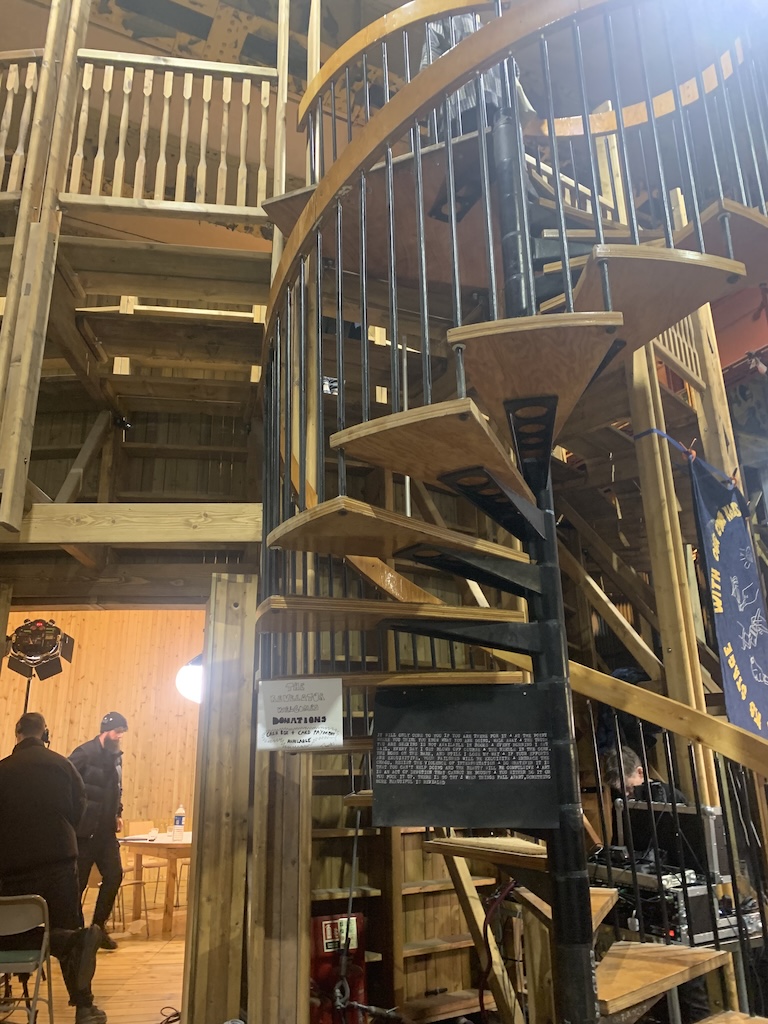
Talking to five members of the panel on the phone earlier I had a sense of the depth of feeling, and layers of complexity in each question. We would have up to an hour to tackle them – too short, but maybe also too long. We had been warned. The Revelator is an extraordinary creative community hub brought to life by Glasgow-based artist Stephen Skrynka. It would be a challenging space to heat at the end of February.
But here we were embraced by a welcoming Wall of Death and if the temperature was on the chilly side the discussion soon warmed up. Energising and often full of surprises.
‘I was born British’
I won’t attempt a detailed report, the event was filmed by Inner Ear and will be shared publicly by GCHT as part of their new series Stones, Stories, Streets. But the hour went quickly, even if some of us took to warming hands on cups of hot drinks and were glad of a small heater puffing warm air at our knees beneath the round table.
However, here’s a glimpse of the group’s generous spirit from the last round. What stories or events would the panel like to emerge in the near future?
Dr Harriette Campbell – co-founder of the African-Caribbean Association for Women (men too in the Elders group) – had spoken movingly about their often-unrecognised work in the health services, the stories that needed to be told soon while the oldest are still alive. ‘I was born British,’ she said with a smile and emphatic energy. Born in the British colony of Gambia before independence (February 18, 1965) she would now like to see colonial history included in the Scottish curriculum and taught with respect for all British citizens.
Respect was picked up by Jen Novotny, Diverse Heritage Project Officer of the Scottish Civic Trust. Respect is a matter of understanding obstacles and underlines the need to make the Trust’s Open Days truly open. ‘It’s not enough to open doors, sometimes you have to take the extra step, to go out and bring people inside.’ To make them feel welcome. Now she was eager to go out and hear for herself the many different untold stories, ‘before they are forgotten.’
Bash Khan, a Glasgow-born filmmaker, photographer and visual artist, had spoken about his father’s arrival from Pakistan, the untold stories of neighbourhood shops open all hours, ‘getting up early to sell the Sun.’ But he also saw the need to tell the stories of white Scottish communities, ‘they often feel neglected,’ adding that stereotypical stories of hopelessness could become self-fulfilling prophecies. ‘Those stories become part of the local identity, we need to celebrate achievement.’
Dr Rosie Spooner, Lecturer in Information Studies at Glasgow University, had opened discussion of the first question (Whose or What Stories are Missing?) by looking at the legacy of colonialism and empire built in stone across historic Glasgow. Her Critical Walking tours round Kelvingrove have brought an understanding of how walking can gently stimulate talking with time to explore and learn from others. ‘With each walk I learn something new.’
And so, to Marjanna Antoniak, Glasgow network coordinator of Migrant Voice, who arrived from Poland eight years ago barely speaking any English and now eloquently describes how communication is not just about words. Beaming, despite the cold, she made everyone smile with imaginative ideas for ‘bringing diversity out from behind closed doors’ breaking free from ‘them and us’. Inclusion means reaching out. How about pop-up exhibitions in local shop windows, cafes, community centres?
Challenging stereotypes
Looking back, I don’t recall any disagreement. Coming from different points of view the speakers met with a shared understanding of the importance of people making person to person connection, getting to know each other, to overcome fear of the other.
There’s very much more to learn from a discussion which challenged many stereotypes. I am looking forward to all three videos. Meanwhile I owe special thanks: to the warm-hearted Stories panel; to the skilled Inner Ear team who filmed us so discreetly we pretty much forgot they were there; to Stephen Skrynka who welcomed us to his inspiring round space; to Katharine Neill, Heritage Officer of GCHT, who invited me to chair the panel and kept me well informed. And, last but not least, to Ian the taxi driver – I asked his name because he specially waited to make sure I had safely arrived at the right warehouse and left with a big smile when Katharine appeared to look for me.
I hope to return to The Rrrevelator – Stephen has many stories to tell. I now know he has ridden a Honda 175 round the wall, and the stairs spiralling up to the viewing platform are inscribed with the names of women because, he tells me, women make the best Wall of Death riders. Ian will be pleased to know.


Leave a Reply