
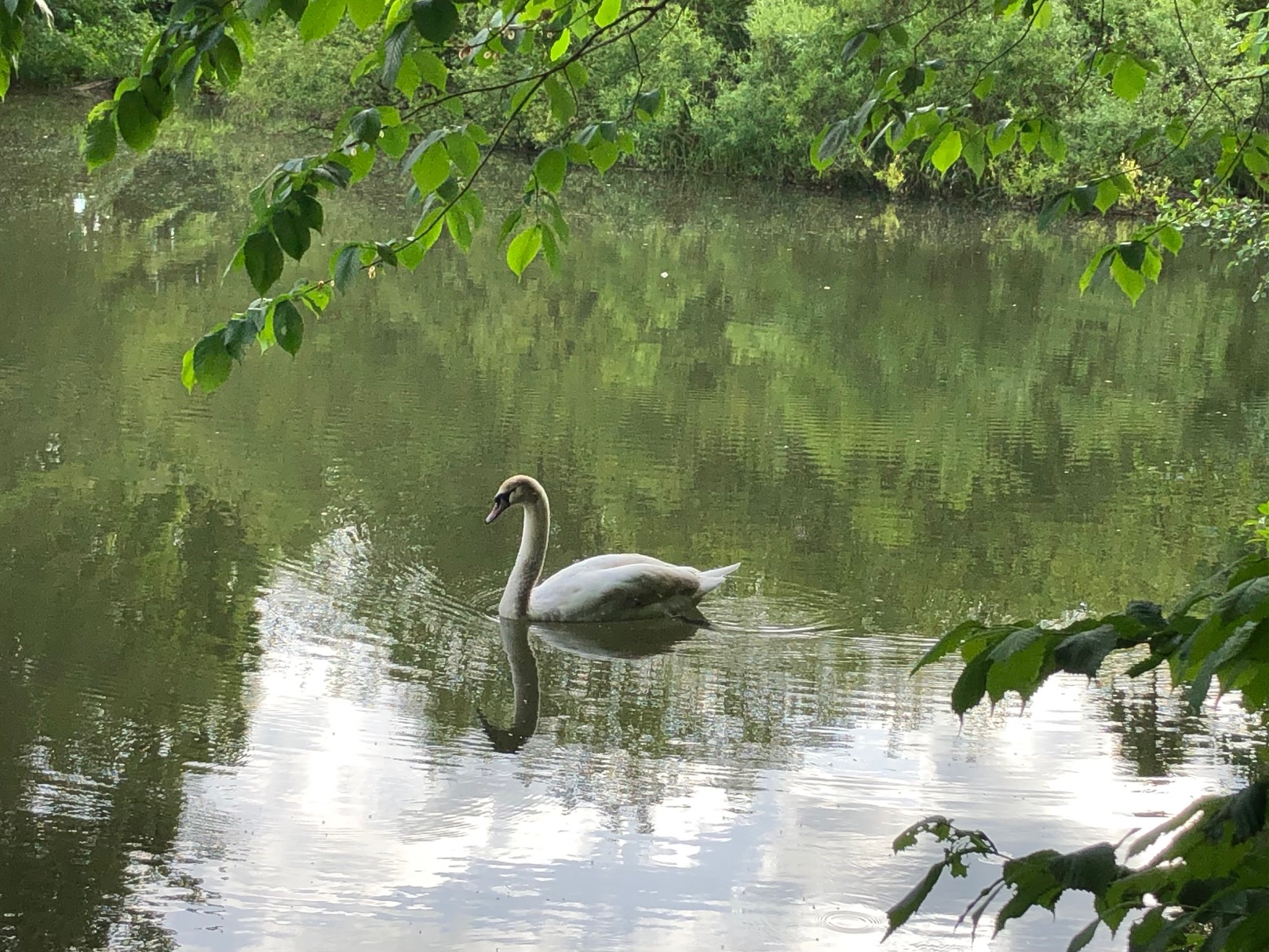
Do swans grieve? Do they mourn for a lost mate or sibling? I’m watching a lonely young cygnet standing on the bank of the pond, head lowered, wary and watchful, unmoved by the rain. Relentless rain. It’s a mournful scene but is that just my human emotion?
Two days earlier this young bird was with a brother (or sister) watching me advance with a scoop of grain at dusk. They snorted and cheeped their appreciation seemingly in good health. I enjoyed their familiar cheery welcome.
Next morning when Ray went out with their breakfast only three cygnets arrived at the feeding point with their parents. Surprised, he looked across the pond and there was the fourth lying neck outstretched on the edge of the island beyond our reach.
As required by law, we reported the death to DEFRA whose main concern is evidence of bird flu. There’s no other sign and a local outbreak seems unlikely. So we must stand back and wait for a turn in the weather allowing us to retrieve the dead body. Cause unknown. We are left with a sense of loss which probably reveals as much about us as the emotions of any wild creature. This family has been an active, sometimes challenging, part of life at Pond Cottage for almost a year. But swans have been a focus of our pond community for more than 20 years and each year, each family, is different. Climate change is urging us all to adopt different behaviour. More of that later.
The question of grief
Do swans grieve? I type the question into my search engine and produce a choice of serious answers. Yes. And no. It depends what we mean by grieving. But the Institute for Environmental Research and Education (IERE) answers at length and suggests that successful conservation requires respect and human empathy with the unspoken emotions of wild creatures.
While attributing human emotions to animals is tricky, evidence suggests swans experience grief and attachment that can resemble human heartbreak.
IERE:
That doesn’t deal with the cygnet’s behaviour. But the IERE article examines the emotions of adults losing cygnets and cygnets losing parents. Another site, Swan Life, documents a female swan who seems to be carefully ‘burying’ a dead cygnet. When birds make a pair bond they experience a sense of loss which can be distressing, sometimes even fatal.
No room for sentimentality
It’s not always for life, but swans’ pair bonding makes for devoted and successful parenting. In stormy weather we’ve seen mother swan transporting tiny bundles on her back to safety. One spring we heard a fierce agitation on the water and found the two adults, wings beating the water violently, protecting their brood as they lunged at an otter. The otter quickly retreated.
But it’s always complicated. There’s no place for sentimentality in the laws of the jungle (or what’s left of it). We’ve learned that even these proud parents don’t cosset their young. In the early phase of our relationship with swans it puzzled us that the adults would regularly march their young round and round the garden. Until one day five cygnets went out for the daily walk but only three came back. What happened to the other two we never discovered. But that eugenic tendency has appeared many times: weaklings are despatched, only the fittest survive to breed the next generation.
Two years ago there was a tragic twist to the Oedipus tale when father turned on son. A young pair of adults, possibly first time parents, had hatched only one cygnet. They seemed an idyllic family. For almost a year they were inseparable. Then when a new mating season arrived the adults began to drive their only child away. He refused to leave. The pond was the only home he had known. Previous families had left the pond soon after hatching, paddling down stream towards Loch Leven before the moult when they would be unable to fly and more vulnerable to attack.
Nature’s way?
Not that year. The swans had never left the pond, nor taught their youngster how or where to fly. Then the adults seemed to give up, they flew away leaving their cygnet behind happily hanging out with a few mallards. Two days later the adult male returned and though we didn’t see the attack we heard loud splashing on the pond. Father left again. It was a while before we saw his cygnet lying on the edge of the island, badly wounded.
It’s not unusual behaviour, we’ve discovered, though I still find it odd that the male would return with such deadly intention. I know this is a personal projection, but it hurt to watch the suffering of such a beautiful young bird.
We were immensely grateful to the young SSPCA officer who came to rescue the wounded cygnet and took him to their sanctuary. Despite their extraordinary care – they gave him medication and fed him through a tube – he never properly recovered and had to be put down.
The pond has known gentler males and kinder couples. An endearing childless pair spent a stormy winter and spring with us in 2022. The poor female had developed a strangely twisted neck (the SSPCA officer thought she might have had a stroke, “Best not to interfere unless we have to,” he said, “disturbing her might distress her mate.”) She wasn’t interested in her mate’s attempts at mating but he stayed loyally close to her until one day, despite her disability, they both flew away.

Determined to survive
Now we watch this year’s family sometimes fearfully but with affectionate admiration. What a pair! This hasn’t been an easy year but they are determined to survive. The male arrived first, swooping in with that distinctive whistling of wings in December 2024. He had settled nicely by the time brutal Storm Éowyn blew in with hurricane force 99mph gusts so fierce Ray and I were unable to step outside.
‘Our’ swan positioned himself in the middle of the pond well away from the risk of falling trees. For six hours or longer, he faced Éowyn paddling ceaselessly to stay in his chosen position. An astonishing display of strength and stamina. He left a month or so later and soon returned with an elegant young mate who hatched six cygnets in a nest they built together near the sluice.

A good and good looking mother (she inspired a painting) she kept them close, often snuggled under her wings during more storms in a cold wet spring. She is still wary of us, despite the daily food we provide, but her mate is not afraid, he knows who we are. And where we live. During the summer he led the young family on many early morning raids to knock – literally – at our front door.
This was new behaviour. Daddy Swan was letting us know he had hungry beaks to fill and they couldn’t wait. It worked. Although six cygnets became four sometime during the summer, the rest grew strong and confident.

The new normal
Climate change has disrupted the old seasonal rhythms. Extreme weather fills the pond with brown water as farm runoff adds another layer of silt preventing the growth of healthy green weed. We humans have made such a mess of the natural order it seems only right to redress the balance – so we supplement the swans’ diet with mixed grain.

We are co-dependents, if you like. We don’t just want these beautiful birds to survive, we need them to. Symbols of nature’s resilience. Besides, the parents have shown imaginative skills of their own. On warm summer and autumn days they organised frequent grazing parties in the long grass of our would-be wildflower meadows. Recently on rare dry days there have been flying lessons across the pond and out into the garden. One morning I opened the curtains to see a cygnet flying low past the window following the line of the garden path like a trainee pilot learning the lie of the land.
Since I started writing this post the sad, lonely cygnet has rejoined the rest. They spend a lot of time preening on the bank but greet us with grateful (I think) snorts and honks. In more optimistic moments it occurs to me that the new generations of swans might adapt to climate change more quickly than us old folks. Since hatching, storms are their new normal. But we do have a duty to help them make the best of it. In a developing story, we hope to see this chapter end with a safe, successful take off.

More stories in Swans of Pond Cottage
Leave a Reply