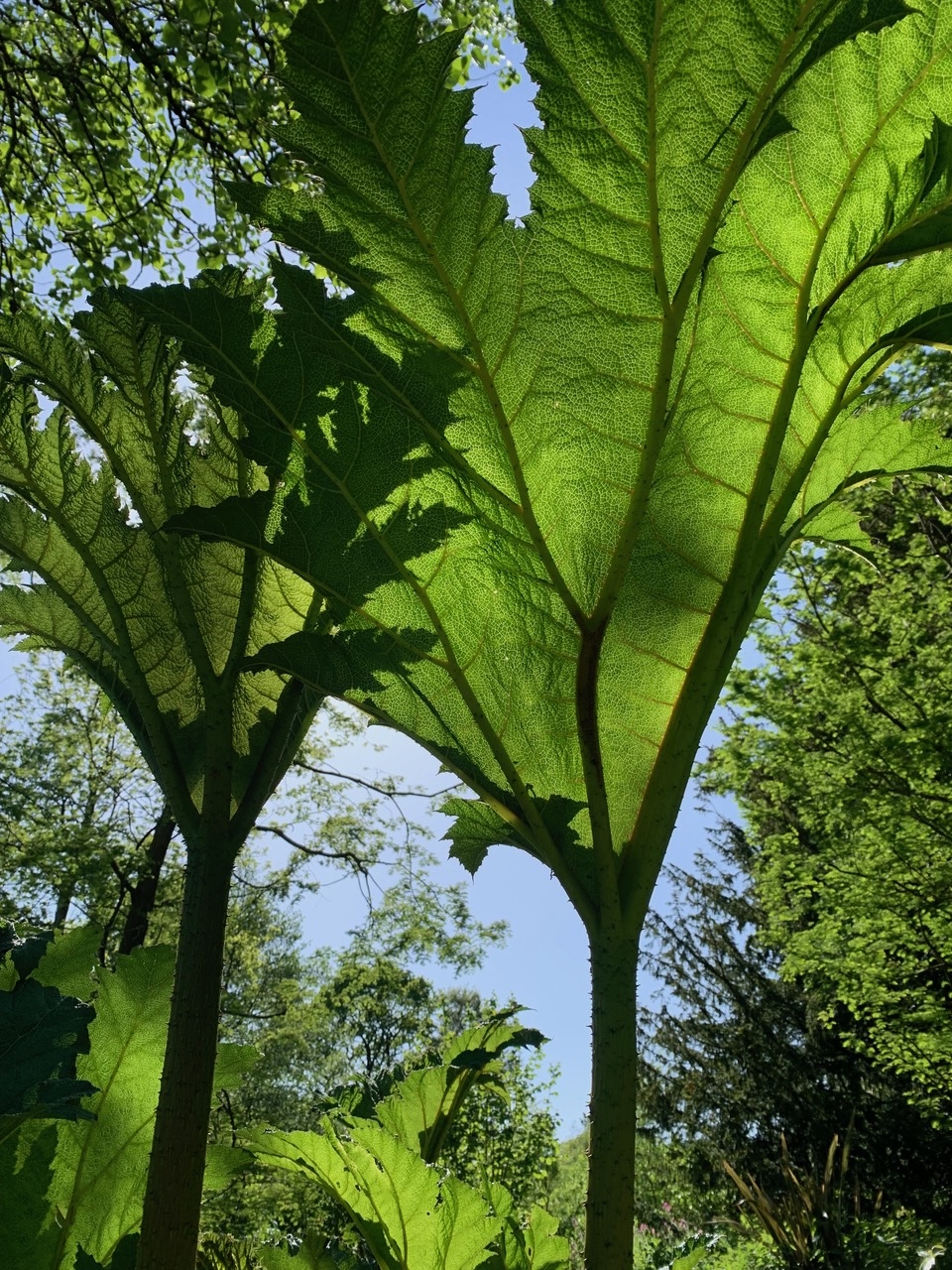
The temperature is veering towards 24C, close to the heatwave edge for this part of Scotland according to the Met Office. It’s hot work weeding the ground elder trying to smother our ‘prehistoric’ planting so I take shelter beneath the Gunnera leaves.
I can’t resist a photograph. Looking up to the hot blue sky, the sun is filtered through jagged leaves, picking out every vein. Despite the cooling green tranquility of the moment, I can’t resist sharing it on Instagram, which links to Facebook (in the age of the *anthropocene, Zuckerberg’s metaverse has ways of keeping us hooked).
“Jurassic Pond Cottage” comments a friend, “beautiful.”
Simon hits the spot. I’ve been half-joking about creating a Jurassic glade where garden visitors can explore and discover ancient plants among the newcomers at Pond Cottage. So far we’ve introduced with varying success descendents of the ‘Jurassic’ Gunnera, dawn redwoods and now a monkey puzzle tree – this young one looking, it must be said, a little puzzled in the middle of the clearing where our grandchildren play. “What am I doing here?” this member of a long-distance Chilean tribe might be wondering.
Good question. I’ll try to answer it.
Gardeners have a wandering eye
Most of the eye-catching trees in our ten acres of wet woodland are deep rooted natives planted perhaps 200 years ago by previous owners: magnificent beech, oak, Scots pine along with a few brave old ash, probably self-sown, surviving the spread of dieback.
But most gardeners have a wandering eye and Scotland is full of glimpses of plants from other times and places: the trees, shrubs and flowers collected by global adventurers and plant hunters (many of them Scots) that colour our changing seasons. Although our native flora is limited our endlessly varied climate and soils make it possible to grow many seductive exotics defying the Scottish weather. Climate change is adding a twist of urgency to the quest to grow the right plants in the right places. How safe are our natives in a time of accelerating extremes?
I was lucky to be introduced to some of Scotland’s great gardens and gardeners during an unforgettable 15 years working as a freelance writer with the Royal Botanic Garden Edinburgh, with occasional forays into environmental publications, guidebooks and garden magazines. What a treat to meet some of the great pioneering botanists, plant collectors, researchers and growers. They have all made their mark in shaping our experiments in a small corner of Perth and Kinross.
It’s exciting to be among these living links with the long distant past before humans roamed the Earth. Let’s look at a few.
Dawn redwood not just stamped in stone
Visitors often ask about the dawn redwoods (Metasequoia gliptostroboides) on our waterbank, gently touching the feathery leaves. The inspiration for me comes from the grove of ‘fossil trees’ growing at Dawyck Botanic garden in Peebleshire where I was lucky to spend a lot of time in the 1990s. Fossils? You have to think back 90 million years to the Cretaceous period. Metasequoias were thought to be extinct, their story stamped in stone seemed to stop at that date. Until they were discovered alive and thriving in a valley in southern China in the 1940s. Great excitement. Seeds were dispersed to botanic gardens across the world and now they are part of RBGE’s international conifer conservation campaign.
Ours are a mere 20 years old but growing fast. Tree ring research in Australia shows dawn redwoods do well in wet years. Perhaps their future is fairly safe at Pond Cottage – if rainfall keeps pace with summer warming.
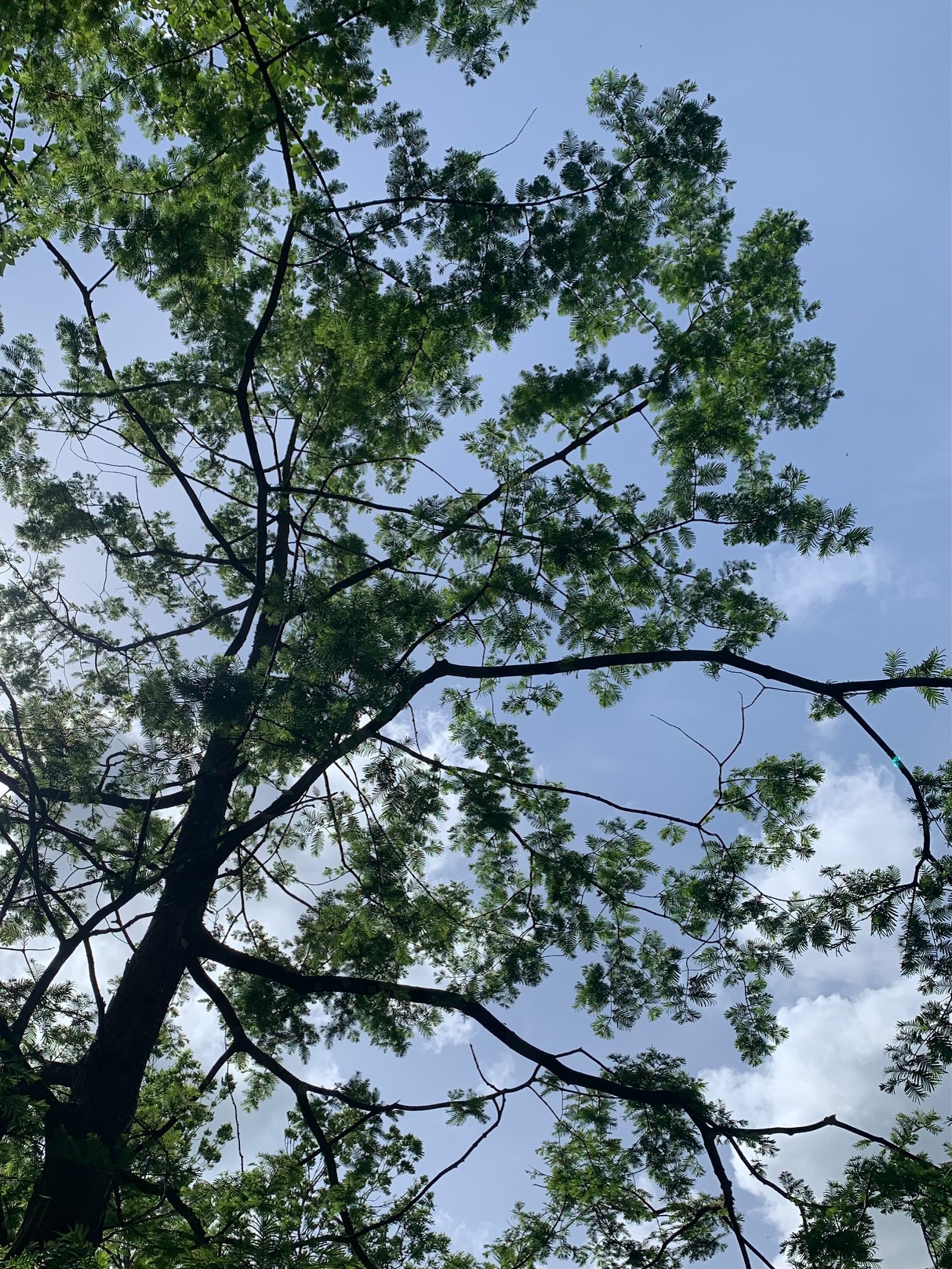
Touching a monkey puzzle
Relics of the Jurassic, some 200 million years ago, Monkey puzzles (Araucaria araucana) were first introduced to Britain by the Scottish explorer Archibald Menzies after a visit to Chile in 1795 when he was treated to a dish of strange seeds by the Viceroy of Chile. He brought some home. They were planted at Kew and I’m trying to imagine his reaction when the first spiky saplings appeared. They caught the eye of William Lobb an enterprising nurseryman who took himself off to Chile and made a lot of money from the more than 3000 seeds he brought back – whetting an appetite for drama in gardens great and small across the UK.
But it’s another more personal story I always think of, told to me by a Chilean musician friend of a friend, Carlos Arredondo, who found refuge in Scotland after escaping Pinochet’s brutal coup in 1974. Making a new life and home in Edinburgh where his children were born, he took his young son and daughter regularly to visit the wonderful trees of home growing in the Botanics. The national tree of Chile is now endangered in its homeland and also part of the global conifer conservation programme. In Chile (and notably at Benmore Botanic Garden’s Chilean hillside) they grow on exposed hillsides, I hope ours settles into the old quarry clearing.

Dining with dinosaurs?
So to the pre-historic clump at the foot of the waterbank and a different kind of story. The ‘giant rhubarb’ eaten by dinosaurs perhaps 150 million years ago looks very happy this year. But unlike the monkey puzzle and dawn redwood this eye-catcher is not a case for conservation. Quite the opposite, and it’s an example of how gardens can develop complicated relationships with the wider world.
Now the plant is regarded as invasive; it’s illegal to buy or sell Gunnera. The RHS says existing plants don’t have to be destroyed but we mustn’t allow them to escape into the wild. Invasive? Not at Pond Cottage, we originally (and at that time legally) bought and planted five clumps, now we have only two.
It’s likely that ours is a hybrid. Bought as the Brazilian species G. manicata (apparently now lost to cultivation, says RHS, see HERE) it’s almost certainly the hybrid G.x cryptica – a cross between a big and vigorous brute, G.tinctoria, and less invasive G.cryptica. Whatever. Ours are growing handsomely. We will not let them spread them into the willow wetland and indeed they show no intention of doing so.

Can we halt our human-made Holocene extinction?
A whistle-stop tour through the Mesozoic era barely scratches the surface of this fascinating complicated link between past and present. It’s exciting to touch leaves that first evolved so unimaginably long ago – and of course they are not all ‘exotics’ from the southern hemisphere, there are ancient natives like our tree-house yew, willows and ferns; they also have roots in pre-history (a story for another time).
I have discovered that ‘Jurassic’ seems to be a catch-all term for perhaps three mind-blowing eras of evolving life forms (Triassic, Jurassic, Cretaceous). So many millions of years, it took, for conifers, palms and ferns to emerge, even more before the giant Stegosorus, Diplodocus, T Rex – all those childhood favourites – strode among them.
It was a very green world – and that’s easy enough to imagine in our corner of Scotland (during the time I’ve been reading for this blogpost the temperature has dropped almost 10 degrees and much rain has fallen). Flowering plants did not emerge until the later Cretaceous. Then 66 million years ago the fifth extinction wiped out a lot of life. The asteroid did for the dinosaurs but many plants survived and the flowering plants had cleverly created a seed bank ready to germinate when the climate was right.
So far Nature has proved resilient to the forces of volcanoes, asteroids, meteorites, ice ages and varying atmospheric extremes of the five great extinctions. Now in our very own geological epoch, the *anthropocene, ‘during which humanity has become a planetary force of change,’ the big threat is from us: Homo sapiens. We bipeds emerged a mere 200,000 (300,000 ?) years ago. I hope we become wise enough to stop the Holocene extinction.
Pond Cottage Garden is open to visitors, supporting CHAS (Childrens Hospices Across Scotland) and other charities through Scotland’s Gardens Scheme

Leave a Reply